
4 Field-Proven Actions to Achieve Traceability to Plantation (TTP) in Palm Oil Supply Chains and Why It Matters

Updated: Apr 16
Editor's Note:
This article provides a practical, field‑grounded walkthrough of the four essential steps needed to achieve Traceability to Plantation (TTP) in palm oil supply chains, an increasingly critical requirement for certification, market access, and compliance with emerging regulations such as the EU Deforestation Regulation. Drawing on insights from Sandy Puspoyo, our Project Lead for Palm Oil and an experienced sustainability manager with a decade of hands‑on expertise in NDPE implementation, certification readiness, and traceability system deployment across Indonesia, this piece distills actionable guidance for companies working to build transparent, auditable, and smallholder‑inclusive supply chains.
Traceability has become a core expectation for companies operating in global palm oilmarkets. Sustainability certifications and evolving regulations increasingly require companies to demonstrate where their palm oil comes from and how it is produced. Buyers, regulators, and certification bodies expect clear evidence that palm oil is sourced from legally owned land and free from deforestation, peatland conversion, and other high-risk practices.
To meet these expectations, companies must be able to trace palm oil back to the plantation where it is grown. This is the role of Traceability to Plantation (TTP). TTP provides the operational foundation for credible, auditable, and transparent supply chains, supporting compliance with certification schemes and regulatory frameworks while strengthening supply chain accountability.
It is important to note that TTP functions as an enabling system rather than a standalone compliance solution. While traceability is a required component across certification schemes and regulatory frameworks, it does not, on its own, guarantee compliance with standards such as NDPE commitments or regulatory obligations. Instead, TTP provides the structured data and chain-of-custody visibility needed to support risk assessment, verification, and decision-making across the supply chain.

At Koltiva, we recommend a sequential, four-step approach to achieve full visibility from plantation to delivery. This framework is informed by practical experience from Koltiva’s palm oil implementation teams, including insights from Sandy Puspoyo, Project Lead for Palm Oil, who brings over ten years of experience working with leading palm oil companies in Indonesia and at Koltiva. His work spans NDPE implementation, certification readiness, and traceability system deployment across smallholder-based supply chains.
The following four steps outline how companies can build end-to-end visibility from plantation to delivery, supported by digital tools, field-level practices, and lessons learned from on-the-ground implementation:
Step 1 - Establish a Verified Foundation: Registering Plantations for Credible Origins
Plantation registration marks the starting point of traceability and remains one of the most challenging stages across palm oil supply chains. With global palm oil production reaching 78.41 million metric tons in 2024 to 2025 according to USDA data (USDA, n.d.), and smallholders producing around 40 percent of the world’s palm oil (The Institute for Development of Economics and Finance, 2021), accurate field-level data capture is essential to support credible and transparent supply chains.
At this stage, companies need a clear and verified picture of:
Farmer identity
Land location, captured through polygon mapping
Land legality, such as titles or permits in accordance with national regulations
Number of palm trees and estimated yield
“Why is land legality required in TTP? Companies typically implement TTP to meet certification requirements such as RSPO, ISPO, or ISCC. As part of these requirements, land legality information is commonly requested from farmers,” explains Sandy.
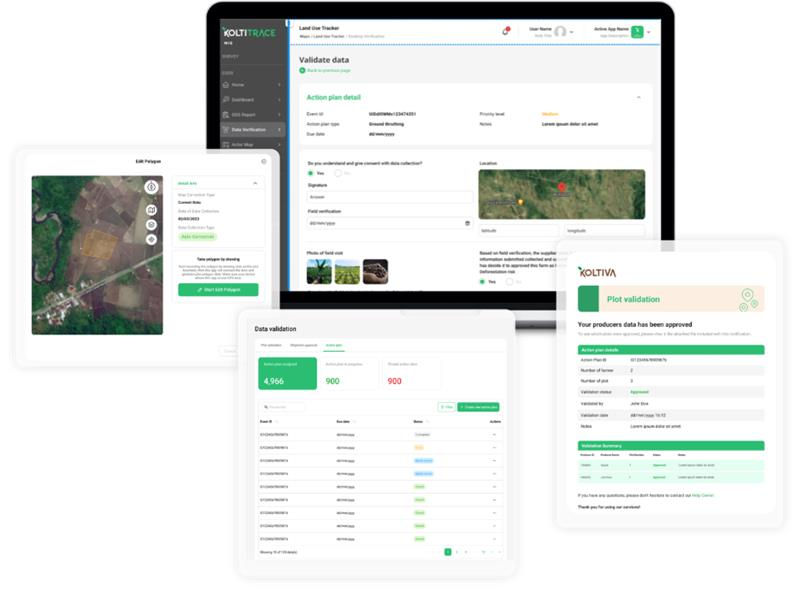
Reliable plantation data provides the baseline for all subsequent traceability activities. Certification schemes such as Roundtable on Sustainable Palm Oil (RSPO) and International Sustainability and Carbon Certification (ISCC) depend on this information to verify the origin of raw materials and confirm legal compliance. Through KoltiTrace MIS FarmXtension, cooperatives and companies can digitize plantation boundaries, securely store land legality documents, and attach supporting evidence including photographs and GPS coordinates.
“From an implementation perspective, starting with higher-risk areas allows clearer and more accurate data capture in the field, which is essential for identifying gaps and determining where remediation, support, and guidance are needed,” Sandy adds.
Step 2 - Connect Harvests to Their Source: Digitizing FFB (Fresh Fruit Bunch) Movements at the First Control Point
Once plantations are registered, the next step is tracking harvested Fresh Fruit Bunches (FFB) as they move from farms to cooperatives and onward to mills. This is where cooperatives play a critical role, acting as the control point where plantation-level data, harvest volumes, and delivery records come together. Ideally, each harvest would be tagged with information identifying its origin and owner after weighing at the cooperative level.
In reality, individual fruit tagging is still uncommon in the field. However, traceability can still be effectively achieved by digitizing delivery notes for FFB (FFB notes) and linking each transaction to registered plantation polygons. By connecting TBS documentation with georeferenced farm boundaries, companies can ensure traceability to plantation without relying on physical fruit tagging at the individual bunch level.
Using FarmGate, cooperatives can fully digitize FFB delivery data, creating a reliable record of how much FFB leaves each plantation and arrives at the mill (a structured and verifiable transaction record). The system captures accurate delivery volumes and dates, links each transaction to its corresponding plantation polygon ID, clearly identifies the farmer or collector, and records mill receipt confirmation. Supporting evidence, such as photos of weighbridge tickets and timestamps, strengthens the chain of custody and improves data accuracy, ensuring data integrity and enabling robust Traceability to Plantation (TTP) without reliance on manual paper-based processes.
This step ensures that every shipment of FFB from cooperatives to mills can be traced back to its plantation, significantly reducing discrepancies and increasing audit readiness for certification and buyer due diligence.
Key information captured at this stage includes:
Delivery date and tonnage
Source polygon ID and sender
Receiving mill confirmation
Step 3 - Maintain Integrity Through Processing: Making Mill Chain-of-Custody Auditable
At the mill level, the focus shifts to operational processing activities, while traceability remains just as important. Once FFB arrives at the mill, companies must ensure that processing records are digitized, accessible, and auditable across the supply chain.
Here, traceability is about data continuity, which means tracking and documenting information across all processing activities, rather than physically segregating every batch. Using FarmGate, mills can record intake volumes, processing activities, and batch-level traceability flows, linking each processed batch back to its upstream or originating plantations. At this stage, companies must also decide how to manage certified and non-certified feedstock while keeping intake records, processing data, and production outputs transparent, consistent, and auditable.
From an operational perspective, some mills apply physical segregation by separating FFB from compliant and non-compliant sources, while others use a mass balance approach, combining feedstock while tracking quotas (for example, 60% certified and 40% non-certified). Both approaches are acceptable under certification schemes, as long as they are transparently documented and consistently reconciled.
This step is crucial for compliance with RSPO, ISCC, and other sustainability standards, ensuring that sustainability claims remain credible and verifiable during audits.
Step 4 - Ensure End-to-End Accountability: Tracking Shipments Beyond the Mill
Traceability must extend beyond the mill gate to achieve full visibility across entire supply chain. For companies selling in regulated markets, shipment-level traceability linked to verified upstream origin data is mandatory, itmust also track logistics, following palm oil products from mills to refineries and final delivery points.
Through KoltiTrace MIS, logistics data such as transport identifiers (e.g., vessel number, destination, delivery date) and supporting documentation can be recorded and linked to upstream batch and plantation information. By structuring this data within one system, companies creates a continuous traceability record that connects physical movement with verified origin data.
This level of end-to-end visibility supports regulatory processes such as the EU Deforestation Regulation (EUDR), which requires due diligence information for each shipment entering the EU. Companies must be able to demonstrate traceability, risk assessment, and documented evidence across the entire supply chain, rather than at a single point in the journey.

Overcoming Common Challenges in TTP Implementation
While Traceability to Plantation (TTP) creates long-term value for supply chain transparency and compliance, its implementation often reveals structural and operational challenges, particularly at the upstream level.
Land legality gaps
A common challenge emerges at the plantation level, where many smallholders cultivate oil palm on land without complete or formal documentation. In some cases, land titles are still in process; in others, boundaries overlap with forest areas or lack official registration. These gaps can delay traceability efforts and complicate certification or due diligence assessments. Addressing land legality therefore requires early verification, clear documentation standards, and cooperative-level coordination to help farmers understand and gradually meet required criteria.
Manual or immature data systems
In many cooperatives, traceability data is still recorded manually, often without standardized formats or consistent validation. Limited access to weighing facilities, fragmented record-keeping, and reliance on paper-based delivery notes increase the risk of data inconsistencies and missing links between plantations, harvests, and deliveries. Digitizing these processes helps create structured records, improves data continuity across supply chain actors, and strengthens audit readiness over time.
Field and logistical constraints
Practical constraints in the field also affect data quality. Remote plantation locations, limited connectivity, and transportation challenges can delay data submission or result in incomplete records. Without aligned workflows between farmers, cooperatives, and mills, traceability systems may struggle to reflect actual operational movements.
Taken together, these challenges highlight that TTP is not a single technical exercise, but a gradual process that depends on data readiness, coordination across actors, and realistic implementation at the field level.
Why Traceability to Plantation Matters
Traceability supports both compliance and commercial objectives across the palm oil supply chain:
Certification requirements
Certification schemes such as the Roundtable on Sustainable Palm Oil (RSPO) and the International Sustainability and Carbon Certification (ISCC) require traceability as a core element to demonstrate sustainable sourcing and enable access to international markets.
Regulatory due diligence
Regulations such as the EU Deforestation Regulation (EUDR) depend on credible, verifiable supply chain data. Companies must be able to provide traceability information as part of shipment-level due diligence for market entry.
Operational clarity
Digitized traceability improves data consistency, reduces discrepancies, and supports clearer coordination between farmers, cooperatives, mills, and downstream actors.
Smallholder engagement
Structured traceability data helps set clearer expectations, supports documentation processes, and strengthens working relationships with smallholders over time.
“These steps don’t directly ensure NDPE or EUDR compliance,” Sandy notes, “but traceability is a required element for certifications and regulatory processes such as RSPO or EUDR, which makes TTP essential.”
Applying Traceability Across the Supply Chain
Traceability to Plantation is built step by step, starting at the plantation and extending through logistics and delivery. When implemented consistently, it enables companies to meet sustainability expectations, certification requirements, and due diligence obligations with greater confidence.
As regulatory scrutiny increases and market expectations evolve, companies that invest in traceability systems today are better positioned to adapt tomorrow.
If you would like to dive deeper into implementation strategies, data requirements, and field challenges, join Koltiva’s upcoming webinar, where our experts will share practical insights from palm oil traceability projects across sourcing regions.
Author: Gusi Ayu Putri Chandrika Sari, Social Media Practitioner at KOLTIVA
Subject Matter Expert: Sandy Puspoyo, Project Lead Palm Oil at KOLTIVA
Gusi Ayu Putri Chandrika Sari combines her expertise in digital marketing and social media with a deep commitment to sustainability, supported by over eight years of experience in communications. Her work focuses on crafting impactful narratives that connect technology, agriculture, and environmental responsibility. She is driven by a passion for promoting sustainable practices through compelling, audience-focused content across a variety of digital platforms.
Sandy Puspoyo is an environmental and sustainability professional with strong expertise in biodiversity conservation, forest ecology, and responsible land-use practices, bringing hands-on experience in High Conservation Value (HCV) and HCSA assessments across Indonesia. With a background in ecological sciences and stakeholder engagement, he has contributed to certification processes such as RSPO through participatory mapping and field-based assessments, and at Koltiva he works directly with independent oil palm farmers—delivering training and coaching on Good Agricultural Practices (GAP), RSPO standards, and key topics like FPIC, HCV/HCS, waste management, and financial literacy, while also guiding them through the full certification process from document preparation to audit support; previously, he led a traceability project in East Kalimantan, managing field teams to map and verify over 1,000 smallholder plots, helping ensure land legality and strengthen transparent supply chains.
Resources:
United States Department of Agriculture, Foreign Agricultural Service. (n.d.). Production – Palm oil (Commodity 4243000). https://www.fas.usda.gov/data/production/commodity/4243000
Hasan, F., Ahmad, T., Fahmid, M. M., & Fadhil, I. (2021). Reducing poverty, improving sustainability: Palm oil smallholders are key to meeting the UN SDGs (INDEF Working Paper No. 1/2021). The Institute for Development of Economics and Finance (INDEF). https://indef.or.id/wp-content/uploads/2023/03/Working-Paper-Reducing-Poverty-Improving-Sustainability-Palm-Oil-Smallholders-are-Key-to-Meeting-the-UN-SDGs.pdf



This is one of the clearest breakdowns I’ve seen of how TTP actually works in practice. The step-by-step approach really shows that traceability isn’t just about systems, but about getting the fundamentals right at each stage.