
Vietnam’s Coffee Sector Must Bridge Data Gaps to Sustain EU Market Access


This publication is adopted from:https://www.agtechnavigator.com/Article/2026/02/12/land-legality-and-plot-level-traceability-challenge-vietnams-coffee-sector-under-eudr/
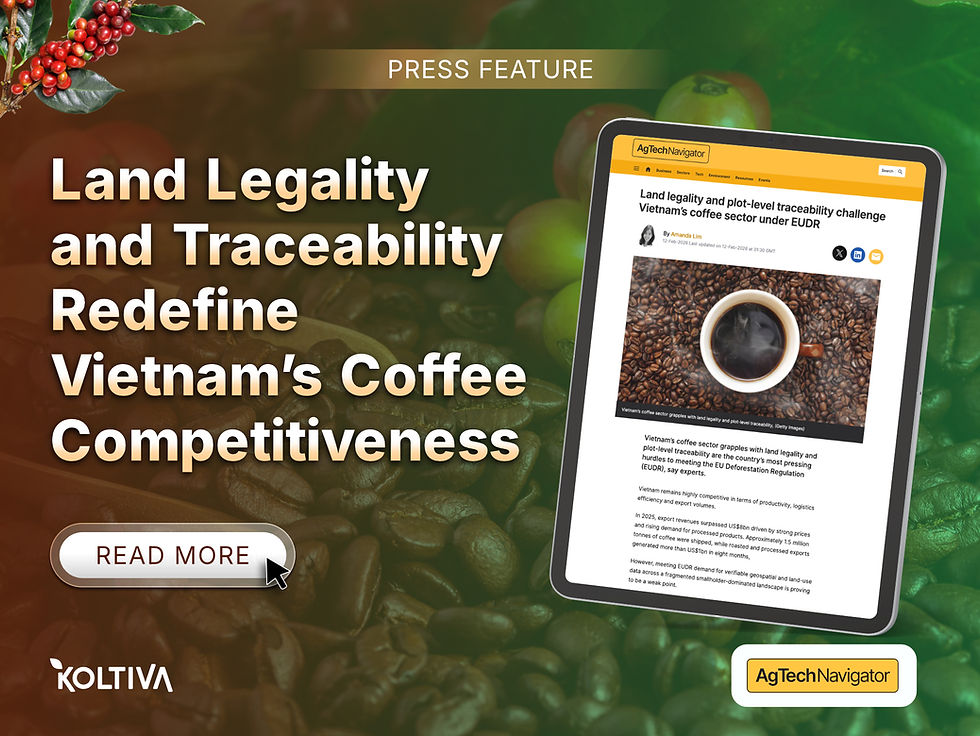
Vietnam’s coffee industry is one of the world’s largest and most influential, with generated export revenues surpassing US$8 billion in 2025 and approximately 1.5 million tonnes of coffee shipped to global markets. Europe remains a core destination for Vietnamese coffee. Yet, the European Union Deforestation Regulation (EUDR) is creating a new compliance test for the sector, especially around plot-level traceability and land legality verification.
Small Farms, Big Data Challenge
Under the EUDR, coffee must be traceable back to individual plots of land with auditable geolocation and historical land-use data. Vietnam’s production landscape is dominated by dispersed smallholder farms. Many producers do not keep formal or consistent records, which creates a significant data gap at the foundation of the supply chain. A 2025 Forest Trends and Tavina survey found that nearly 60 percent of smallholders did not maintain reliable harvest records, and only about 10 percent kept detailed plot-level data.
According to Lily Tran, Business Development Lead at Koltiva, “The main challenge is plot-level traceability and land legality verification across fragmented smallholder networks. Vietnam’s coffee sector is characterized by small, dispersed farms where record-keeping practices are often inconsistent.”
Why Certification Alone Is Not Enough Under EUDR
Tran also noted that simply holding sustainability certificates is not enough. “In practice, the key differentiator is not certification logos but access to verifiable, auditable data,” she said. “Certification increasingly functions as a supporting layer rather than standalone proof of compliance. Exporters must pair certificates with digital traceability systems to meet EU requirements.”
This shift highlights the need for structured, digital farm-level data rather than traditional paper-based or ad-hoc information, especially for smallholders who have historically operated outside comprehensive data systems.
Digital traceability platforms are becoming more common in Vietnam’s coffee supply chains, and they play a crucial role in mapping and managing data.
However, Manfred Borer, Co-founder and CEO of Koltiva, stressed that technology alone cannot overcome all barriers. “Digital traceability is a strong enabler for mapping, record-keeping, and supply-chain linkage. However, technology alone cannot fully resolve land legality gaps, producer training needs, or institutional data alignment. Its effectiveness increases when paired with cooperative organization, governance support, and consistent data standards. In other words, digital tools are necessary but not sufficient on their own,” he said.
Another compliance hurdle is land legality verification. Even farms that are deforestation-free can face issues if land-use documentation or ownership records are incomplete. Tran highlighted land legality as “often a hidden bottleneck,” noting that strengthening local record systems and registry alignment is as critical as environmental verification.
The Stakes for Vietnam’s Coffee Industry

As EUDR deadlines approach, many European buyers are prioritising suppliers that can demonstrate transparent, compliant data systems quickly and reliably. Exporters with verifiable plot-level traceability are likely to secure longer-term and premium contracts, while others may find their access to some EU segments constrained.
Vietnam’s coffee sector is expected to remain an important supplier to the EU. Yet the transition under EUDR, that is due to enforce this end of 2026, will reward actors that invest in data infrastructure, producer engagement, and collaborative governance to make traceability and legality visible and auditable.
Digital traceability systems such as KoltiTrace are increasingly being deployed to map producers at plot level, capture geolocation coordinates, record harvest and transaction data, and structure documentation in line with evolving regulatory requirements, including EUDR. By digitising farm profiles and linking them to supply chain transactions, these systems help exporters establish clear, verifiable data trails from origin to buyer.
Effective compliance, however, extends beyond technology. It requires consistent data validation, field-level verification, and sustained engagement with producers, traders, and exporters. When digital infrastructure is implemented alongside structured field support and multi-stakeholder collaboration, traceability becomes not only digitised, but credible and inclusive. In this context, EU due diligence standards are reshaping global trade—making structured farm-level data a foundation of Vietnam’s long-term competitiveness in the European market.


Clear signal that data is becoming a competitive advantage, not just a compliance requirement. Those who invest early in structured, farm-level traceability will likely define the next phase of market leadership in Vietnam’s coffee sector.