




50 minutes ago14 min read

Editor's Note:
Ask a procurement or sourcing team what EUDR compliance actually requires, and the answer usually stops at the farm gate: map the plot, geotag it, file the Due Diligence Statement. That assumption is worth challenging, because it's incomplete in a way that costs money. The stage where most food loss actually happens, harvest to retail, not the farm itself, is also the stage where traceability records most often break down. A geotagged plot doesn't stay compliant on its own if what comes off it is poorly dried, poorly stored, or changes hands through an untracked trader before it ever reaches a buyer.
We see this pattern directly in our own post-harvest work, cocoa especially: poor drying and storage technique that degrades a harvest before it's even sold, and missing or informal transaction records once a crop changes hands between farmer, trader, and buyer. Both are post-harvest problems in the ordinary sense. Both are also compliance problems, because a break in either one breaks the same traceable chain a Due Diligence Statement is supposed to prove exists.
This is an argument we've made in various rooms this year, including a regional industry session earlier in 2026; what follows is Koltiva's own view, built from what we see daily across our field operations in 94 countries, that closing the post-harvest gap takes both a digital record of what happened on the ground and a person who can actually change what happens there, which is exactly the pairing behind KoltiTrace and KoltiSkills.
Executive Summary:
Supply chains can be fully EUDR compliant on paper (Coordinates Mapped, Due Diligence Statement filed), but still lose the product, its quality, and its traceability record the moment harvest ends. Compliance at the farm gate doesn't guarantee integrity past it.
Despite that, a recent mapping of digital agriculture tools in Indonesia found only 2.1% of the technologies adopted by producers target post-harvest handling. Most cluster around planting, maintenance, and marketing. That leaves the highest-loss stage of the value chain the least served by innovation (Beanstalk, 2026).
This isn't a technology shortage so much as a targeting and infrastructure problem. Post-harvest solutions have to combine compliance tracking, quality management, and often storage or logistics capacity, rather than a single point solution addressing a single pain point.
Reframed through that lens, EUDR isn't a paperwork exercise, it's a forcing function accelerating investment the post-harvest stage has gone without for years. Compliance readiness becomes a byproduct of doing post-harvest handling well, not the goal itself. That's the operating principle behind how Koltiva pairs KoltiTrace (traceability software) with KoltiSkills (boots-on-the-ground extension services), digital records without field presence just document preventable loss; field training without data never becomes auditable.
Closing the post-harvest gap isn't the responsibility of any single actor in the chain. It requires shared investment across industry buyers, financiers, and technology and field-service providers, treating post-harvest infrastructure as collective supply-chain infrastructure, comparable to roads or cold storage, rather than a service any one-party purchases from another.
Table of Contents
The Blind Spot Nobody's Pricing In
EUDR Was Never Really About Paperwork
The Missing Layer: Why Software Alone Doesn't Save a Harvest
Koltiva's Proposition: Where KoltiTrace Meets KoltiSkills
What This Looks Like on the Ground
Building Shared Responsibility, Not a Single Bill
What This Means for Buyers and Investors
FAQ (Frequently Asked Questions)
The scale of global food loss is well known even if the exact figure is debated. The FAO's long-standing estimate is that roughly one-third of all food produced for human consumption, about 1.3 billion tonnes a year, is lost or wasted. More recent FAO and UNEP figures break that down further: an estimated 13–14% of food is lost in the supply chain after harvest and before it reaches retail, with another 17–19% wasted at retail, food service, and household level (Stop Food Loss and Waste, n.d.). Food loss and waste is also estimated to account for 8–10% of global greenhouse gas emissions. That's a useful way to hold the number in mind: every tonne of food lost after harvest carried a real cost in water, labor, land, and emissions that was spent and never recovered.
What’s less widely understood is where the investment to fix this has actually gone. A mapping of digital agriculture tools adopted by producers in Indonesia, presented at RAFT APAC's second session by Beanstalk (Rescuing the Missing Third: Session 2 of Regional Agri-Food Transition Network/RAFT APAC), found that the vast majority cluster around planting, maintenance, and marketing. Only 2.1% target post-harvest handling, the exact stage FAO identifies as responsible for roughly a third of all food loss. It matches what we see in our own field operations across cocoa, coffee, palm oil, and a dozen other commodities.
The instinct is to read a gap like that as a technology shortage. It isn't. The underlying innovation already exists: digital scales, moisture sensors, cold-chain logistics platforms, and quality-grading tools are all commercially available. What's missing is integration. A planting-stage app can succeed as a single point solution. It recommends a planting window or flags a pest risk, and its job is largely done. A post-harvest solution can't get away with that. To actually prevent loss, it has to combine several things working at once: a digital record of what was harvested and when, a compliance trail that survives regulatory scrutiny, a quality-grading mechanism, and in many cases physical storage or transport capacity. None of that runs on software alone, a compliance trail still depends on someone in the field verifying what the data says happened. That's a materially harder problem to build, sell, and scale than a single-purpose app, which is a large part of why so little agtech investment has gone there.
The problem also compounds specifically at the smallholder level, where EUDR-covered commodities are concentrated. Cocoa, coffee, and palm oil are grown overwhelmingly by producers working two- to five-hectare plots, often without reliable storage, without price information, and without the negotiating leverage to wait for a better offer. In West Africa, cocoa growers have historically captured only 60–70% of the international price for their beans, compared to roughly 90% for producers in more consolidated markets such as Ecuador (Reuters, 2025). Part of that gap is driven by producers selling immediately after harvest out of necessity, rather than storing until conditions or prices improve. Post-harvest investment isn't just a loss-prevention question. For millions of smallholders, it's directly an income question.

Under Regulation (EU) 2025/2650, the EU Deforestation Regulation now applies from 30 December 2026 for large and medium operators, and 30 June 2027 for micro and small operators, the second postponement since the rule was adopted in 2023. It covers cocoa, coffee, palm oil, rubber, soy, cattle, and wood, along with derived products, and requires operators to demonstrate through geolocation data that goods were not produced on land deforested after December 2020. The European Commission's May 2026 simplification review confirmed no further delays to the underlying text are planned, and a further round of implementing measures followed in July 2026. The direction of travel is settled, even if the exact deadlines have moved.
Most coverage of EUDR treats it as a documentation exercise: collect coordinates, generate a Due Diligence Statement, submit it, move on. That framing captures the mechanics but misses the substance. EUDR's covered commodities, cocoa, coffee, and palm oil chief among them, are precisely the commodities where post-harvest handling determines both product quality and supply-chain traceability at the same time. A cocoa shipment that spoils in inadequate storage, or that passes through an untracked intermediary trader, isn't only a food-loss event. It's also a supply chain that has lost its verified link back to the farm, the exact link a Due Diligence Statement is supposed to prove exists.
This is worth restating plainly, because it changes how the investment case should be framed. A buyer who treats EUDR purely as a compliance cost is solving for the audit. A buyer who understands that post-harvest handling and traceability integrity are the same underlying problem is solving for the audit and for the loss, quality, and farmer-income issues that were costing money long before this regulation existed. Compliance, in that framing, follows from doing post-harvest handling properly. It was never really the objective driving the investment.
It's also worth noting that EUDR won't be the last regulation to demand this. Due diligence and traceability requirements are proliferating across markets: the EU's own human-rights due diligence rules, and a growing set of import-safety and supply-chain-visibility requirements elsewhere, point the same direction. Buyers who build post-harvest infrastructure now, in response to EUDR, are building a capability that will very likely be required again under a different regulation's name within a few years. That's the strongest argument for treating this as infrastructure investment rather than a one-off compliance project.
A digital traceability platform can tell a buyer exactly where a shipment of cocoa came from, when it moved, and who touched it along the way. What it cannot do is teach a producer how to dry that cocoa properly or tell a cooperative manager that a batch is three days from spoiling. That gap, between having data about a harvest and having the capacity to actually protect it, is where most post-harvest strategies fail.
This isn't a view unique to Koltiva. At the RAFT APAC session, Wavemaker Impact's Subhadeep Sanyal made a related point from an investment perspective: physical infrastructure and digital tools have to move in tandem, because neither succeeds in isolation. He pointed to a portfolio example in low-carbon rice production, where the underlying agronomic technique had existed for years. What was missing wasn't the science; it was the incentive and delivery structure that made producers willing and able to adopt it. It's a useful outside confirmation of something we've built our own operating model around: technology creates visibility, but visibility alone doesn't change what happens on a drying rack in a village three hours from the nearest paved road.
Ainu Rofiq, Koltiva's Co-Founder, made the same point from inside the company at the same session. "Technology itself cannot solve everything. That's why we deploy our field agents and provide boots-on-the-ground services to coach producers on good agricultural practices. This also includes proper post-harvest handling: sorting, processing techniques, and maintaining crop quality and shelf life,” said Ainu.
In our own field operations, the pattern repeats across commodities. A farmer-facing app can record a transaction the moment it happens, replacing a paper ledger or an Excel sheet that may or may not exist. But the app doesn't stop a batch of coffee from over-fermenting because nobody explained the timing, and it doesn't stop a cocoa buyer from rejecting a shipment because the farmer used an input the buyer's specification prohibits. Those outcomes are determined by what happens physically, at the farm and in the first stretch of the supply chain. That's exactly the layer that generic “digitize the farmer” strategies tend to skip.
Koltiva was built around the idea that closing this gap requires two connected layers working on the same problem at the same time, not one team building software and hoping adoption follows. In practice, that means pairing KoltiTrace, our traceability and farm management platform, with KoltiSkills, our boots-on-the-ground extension services arm, and pointing both of them specifically at the post-harvest stage, rather than treating post-harvest as an afterthought to farm-level mapping.
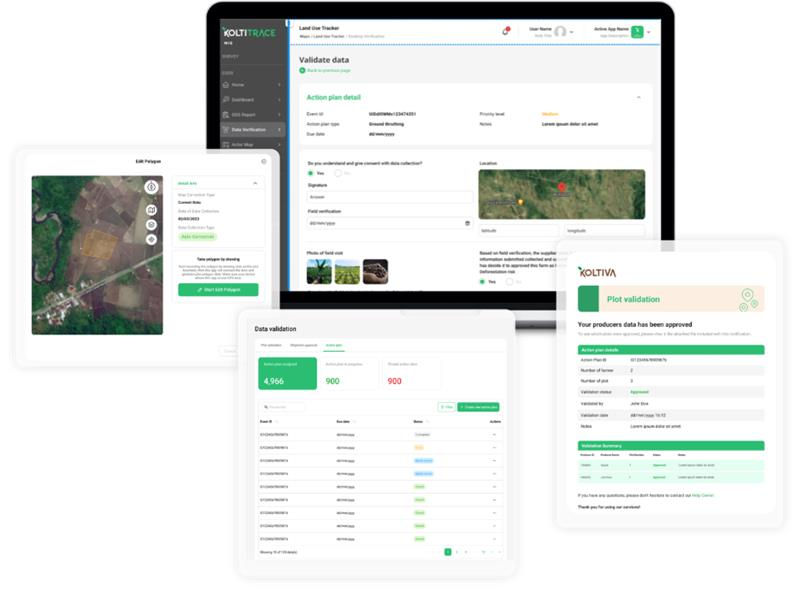
KoltiTrace provides the digital foundation required to monitor products beyond the farm gate. The platform integrates farm management, geolocation and polygon mapping, deforestation and land-use-change (GHG) monitoring, and data-proven traceability into a single Management Information System that follows a crop from seed to table.
For post-harvest specifically, three capabilities matter most:
Digital transaction records replace paper and spreadsheets, giving farmers, aggregators, and buyers a shared, real-time view of what moved, when, and at what quality, rather than a record that may only exist, if at all, on paper at the point of sale.
End-to-end shipment visibility enables companies, buyers to the supply chain operators track produce from the first mile through to factory level, catching the misplaced or delayed inventory that causes spoilage in transit before it becomes a total loss.
The platform's deforestation and GHG mapping layer ensures that the same data trail used to prove a shipment's origin for EUDR compliance also provides visibility into where, across the post-harvest journey, time, quality, and volume losses occur.
KoltiSkills is the part of the model that a dashboard cannot replace. It puts field agents directly in front of the people who make post-harvest decisions: not only producers, but the aggregators, cooperatives, agri-input sellers, and local traders who sit between the farm gate and the factory, and who are often where loss actually accumulates.
In practice this covers four things:
Supply chain mapping and verification, including household-level profiling and farm assessments that go beyond a GPS pin to understand production potential and risk;
Training and Coaching on Good Agriculture Practices, including the specific post-harvest steps (sorting, drying, fermentation timing, storage) that determine whether a harvest survives long enough to reach a buyer in sellable condition;
Business Support for the First-Mile Supply Chain Actors, including product traceability verification, support for agri-input sellers to professionalize their operations, and land legality support that helps producers secure the documentation needed for certification and finance
Certification & Compliance readiness for standards such as Rainforest Alliance, RSPO, 4C, and FSC, which increasingly overlap with what EUDR itself requires.
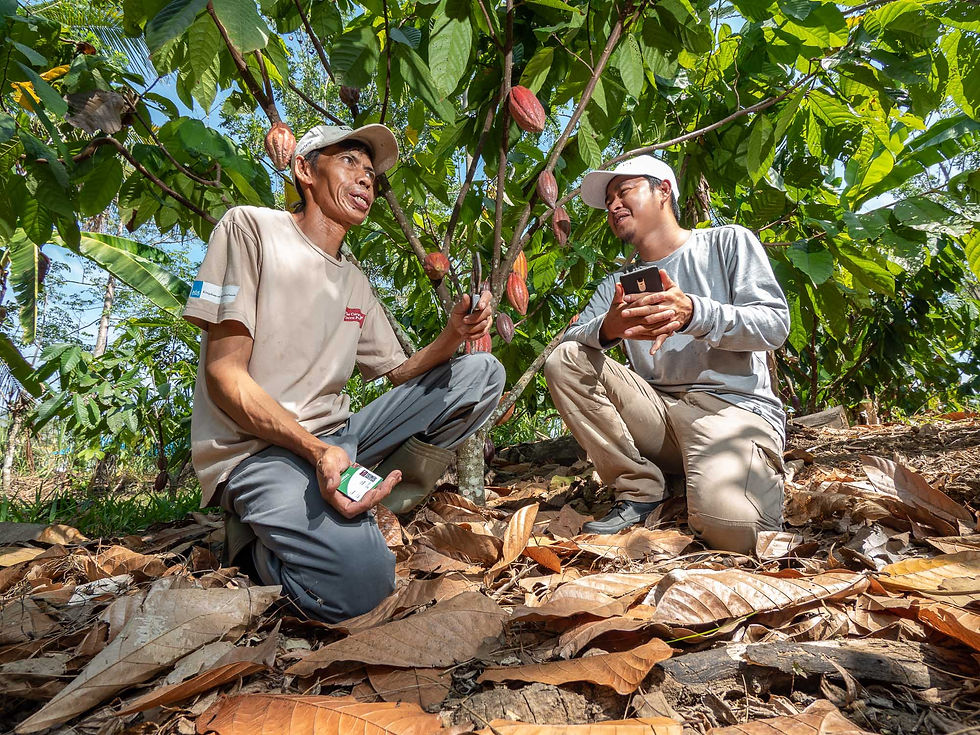
Neither layer solves the post-harvest problem on its own. KoltiTrace without KoltiSkills produces a very accurate record of a preventable loss: a well-documented shipment that still spoiled, because nobody was present to correct a handling mistake before it compounded. KoltiSkills without KoltiTrace produces well-trained producers whose improved practices never become visible or auditable to a buyer, and therefore never translate into the market access or price recognition that would make the training worth sustaining.
Put together, the two create a loop: field agents generate and verify the data that KoltiTrace records, that data shows buyers and Koltiva's own teams where loss is concentrated, and that visibility directs where the next round of field coaching should focus. Compliance readiness, a traceable, geolocated, audit-ready record, comes out the other end of that loop as a byproduct. It was never the input the whole system was built to produce.
In one smallholder cocoa sourcing region, farmers had traditionally sold shortly after harvest regardless of price, in part because they lacked reliable storage guidance and had no digital record of their own sales history to negotiate from. Introducing KoltiTrace's farm-level digital records alongside KoltiSkills field-agent coaching on proper drying and storage techniques gave farmers two things at once: visibility into their own transaction history, and the practical knowledge to store cocoa safely for months rather than sell immediately out of necessity. With proper handling, cocoa can typically be stored for several months without significant quality loss. Without it, quality (and the price a farmer can command) degrades quickly, and a rejected or downgraded batch often ends up resold into a lower-value local market instead of the buyer's supply chain.
The same combination applies to input quality. KoltiTrace tracks the agricultural inputs a farmer uses alongside their harvest data, while KoltiSkills works directly with local agri-input sellers to improve what's available and how it's used. That matters because inputs that don't meet a buyer's specification (a restricted pesticide, for instance) lead directly to factory-gate rejection, and the farmer absorbs that loss by reselling into a lower-value market. Addressing input quality at the point of sale, rather than discovering the problem at the factory gate months later, is a post-harvest intervention in every sense that matters, even though it happens before harvest.
In both cases, the compliance outcome (a traceable, geolocated, EUDR-ready record of the crop's origin, handling, and inputs) was a byproduct of work that started from loss prevention and farmer income, not from a regulatory checklist. That's the order we think the sector has, in aggregate, had backwards for the better part of a decade: building traceability systems to satisfy a regulation, rather than building post-harvest capability that happens to satisfy the regulation along the way.
A fair question follows from all of this: who pays for the infrastructure that closes the post-harvest gap? It's tempting to treat this as an unresolved weakness, as though the answer is simply that nobody wants to fund it. We don't think that's the right read. The more useful framing, and the one that matches what's actually working in the markets where post-harvest investment has scaled, is shared responsibility across the value chain rather than a bill any single party is expected to pay alone.
Industry buyers who fund post-harvest infrastructure gain supply security, reduced quality rejection, and EUDR readiness in the same investment. Financiers, particularly development finance institutions and impact investors willing to absorb early-stage risk that purely commercial capital won't, gain a de-risked, increasingly traceable asset class as post-harvest data quality improves. Technology and field-service providers, Koltiva included, gain the scale needed to make the underlying model economically sustainable, since the cost of a field agent's visit or a farm assessment falls as the network around it grows. Each party's contribution makes the others' investment more viable. That's closer to how roads or cold-storage infrastructure get built, through blended, overlapping investment, than to a transaction between a single buyer and a single service provider. It's the model we'd encourage buyers and financiers evaluating this space to look for.
For companies sourcing EUDR-covered commodities, this argues for evaluating traceability and post-harvest investment together rather than as separate line items. A traceability platform that can produce a Due Diligence Statement but has no mechanism for improving what happens on the ground between harvest and delivery only solves half the problem: the audit half, not the loss, quality, or farmer-income half. The reverse is equally true. Field training programs that never generate auditable, geolocated data leave buyers unable to prove, to a regulator or to their own end consumers, that the improvement actually happened.
The organizations best positioned for the next few years of regulatory tightening will be the ones that treat post-harvest handling as core supply-chain infrastructure, worth co-investing in alongside suppliers, financiers, and technology partners, rather than as a compliance cost to be minimized. The missing third isn't missing because the sector lacks ideas; it's missing because too few of those ideas have been aimed, deliberately and jointly, at the stage between harvest and market where the loss actually happens.
What is the “missing third” in food loss discussions?
The term refers to the FAO estimate that roughly one-third of all food produced for human consumption globally is lost or wasted before or after reaching consumers: the portion of the food system that never delivers its intended value.
Why does post-harvest handling matter for EUDR compliance specifically?
EUDR-covered commodities, cocoa, coffee, and palm oil in particular, are also commodities where post-harvest handling determines whether a shipment retains its quality and its traceable link back to the originating farm. Poor post-harvest handling can break both the product and the compliance record at the same time.
Is this primarily a technology gap or an infrastructure gap?
It's an infrastructure and integration gap rather than a shortage of available technology. Post-harvest solutions require compliance systems, quality management, and often physical storage or logistics capacity to work together, which makes them harder to build and adopt than single-purpose tools aimed at planting or maintenance.
Why can't a traceability platform solve post-harvest loss on its own?
A traceability platform can show where a harvest came from and how it moved, but it cannot correct a handling mistake in real time or teach a farmer proper drying and storage technique. That requires people in the field, which is why Koltiva pairs KoltiTrace with KoltiSkills rather than treating software as a complete solution.
What specifically does KoltiSkills do?
KoltiSkills is Koltiva's boots-on-the-ground extension services arm. It covers supply chain mapping and verification, training and coaching on Good Agriculture Practices including post-harvest handling, business support for aggregators and agri-input sellers, land legality support, and certification readiness for standards such as Rainforest Alliance, RSPO, 4C, and FSC.
What specifically does KoltiTrace do?
KoltiTrace is Koltiva's traceability and farm management software. It covers farm management, geolocation and polygon mapping, deforestation and GHG/land-use-change monitoring, IoT-enabled smart farming data, and end-to-end digital transaction traceability from seed to table.
Who should be paying for post-harvest infrastructure investment?
It's best understood as a shared investment across industry buyers, financiers, and technology and field-service providers, comparable to how infrastructure like roads or cold storage gets funded, rather than a cost any single actor in the chain should be expected to absorb alone.
Has the EUDR timeline changed?
Yes. Under Regulation (EU) 2025/2650, adopted in December 2025, the application date moved to 30 December 2026 for large and medium operators, and 30 June 2027 for micro and small operators. This was the second postponement since the regulation was adopted in 2023.
Author: Daniel Prasetyo, Head of Corporate Communication KOLTIVA
Daniel, with over a decade of diverse industry experience, spearheads PR and Corporate Communications. Integrating branding, positioning, and stakeholder engagement into his approach, he plays a key role in supporting business growth and shaping brand perception.
Resources:
High Level Panel of Experts on Food Security and Nutrition. (2014). Food losses and waste in the context of sustainable food systems (HLPE Report 8). Food and Agriculture Organization of the United Nations. https://www.fao.org/cfs/cfs-hlpe/publications/hlpe-8/en
Food and Agriculture Organization of the United Nations. (n.d.). FAO policy series: Food loss & food waste. https://www.fao.org/policy-support/policy-themes/food-loss-and-food-waste/fao-policy-series--food-loss---food-waste
Stop Food Loss and Waste. (n.d.). Facts. https://www.stopfoodlosswaste.org/about/facts
European Parliament. (2025, December 17). Deforestation law: Parliament adopts changes to postpone and simplify measures. https://www.europarl.europa.eu/news/en/press-room/20251211IPR32168/deforestation-law-parliament-adopts-changes-to-postpone-and-simplify-measures
Global Environmental Law Review. (2026, May). European Commission releases new EU Deforestation Regulation measures. https://www.globalelr.com/2026/05/european-commission-releases-new-eu-deforestation-regulation-measures/
Carbmee. (2026, July). EUDR status update. https://www.carbmee.com/knowledge-insights
Li, B., Carter, S., Schneider, T., Labaste, S., Campbell, O., & Zantow, S. (2026, May 15). What is the EU Deforestation Regulation? 8 key questions, answered. World Resources Institute. https://www.wri.org/insights/explain-eu-deforestation-regulation
Angel, M. (2025, September 22). Ecuador set to become world’s No. 2 cocoa grower, industry head says. Reuters. https://www.investing.com/news/commodities-news/ecuador-set-to-become-worlds-no-2-cocoa-grower-industry-head-says-4248525


Comments